Monday, September 22, 2008
FLOW
It was a compelling look at water systems around the world, and a call for action. I thought I would walk away feeling badly for all the people who live in third world countries without access to safe, clean drinking water. And I did. But I also received the rude awakening that our own water systems here in the US are not as safe or as clean (or as stable) as we'd maybe like to believe they are. As if to underscore this point, the AP ran this article today about rocket fuel in public water supplies.
The threat that is posed to people around the world if we don't reign in the power of some of the large global corporations is made clear. Coca Cola's actions in Plachimada, India is an issue that I've addressed previously. What I didn't know is that the Nestle Corporation has threatened and abused local water supplies right here in the United States (namely Michigan).
This is a wonderful film that I would encourage everybody to see if they have the chance. As alarming as the world water situation is, I didn't leave feeling despair. I left feeling that we haven't yet passed the point of no return. There is still time for us to fix what we've broken - and doing that will require, to paraphrase one of the interviewees from the film, for all of us to decide what we value, and to begin acting accordingly.
Thursday, July 3, 2008
Here's what I think about that.
Also, as Organic Needle reminds us, the Coca Cola company owns countless brands. See a really big list of brands owned by Coca Cola here.
To Whom It May Concern:
I received your response to my inquiry regarding the village of Plachimada in India.
Your response was much what I expected, explaining how you hadn’t actually violated any laws. I understand that the court decided you have the right to use local aquifers, but that does not absolve you from your responsibility to do the right thing – and draining a community’s water resources to the point where they can no longer sustain themselves is not the right thing, regardless of what the court says.
Your argument that the water tables would not be adversely affected in conditions of normal rainfall is empty, as you yourself point out that the last few years have not been ones in which normal rainfall has occurred. Apparently your strategy in this case is to carry on as usual despite the fact that the conditions you’ve established to avoid negative environmental impacts have not been met?
I understand that a court ruling in your favor means you may never be held legally accountable for your actions, but I am not bound to judge in accordance with legal rulings, and I am holding you accountable for the damage you’ve done to the community of Plachimada.
Your contention that your biosolids are not hazardous is not comforting. Why were they distributed to farmers in the first place? Because it was the cheapest, easiest way for you to unload your waste? Do you honestly assert that the high levels of cadmium in these solids are not dangerous? If so, you’ve lost all credibility with me. I highly doubt that you’d spread this sludge in your own backyard and allow your children to play in it.
Your product quality information, although interesting, was not the focus of my concerns about your activities in Plachimada.
To reiterate the point of my original letter, which I do not feel has been addressed at all by your response, I would like to know what are you doing to clean up the mess you have made? Although I’m glad that you’ve figured out that in normal rainfall years, you wouldn’t be draining the water tables, and you’ve stopped dumping biosolids on people’s farms, I don’t see anywhere that you’ve addressed the fact that you’ve stressed community water resources in low rainfall years – what are you doing to remedy this? What are you doing to clean up the cadmium in the soil that you are responsible for?
You stated that you do "business around the world honestly, ethically, in compliance with applicable law, and with respect for the basic principles of human decency and justice." Excuse me for saying so, but I disagree. I'd say the only one of these you've got done perfectly is the compliance with applicable law, with some sort of misguided assumption that the rest will follow. Unfortunately, compliance with written law is not a guarantee of honesty, ethical behavior, and certainly carries no assurances regarding basic principles of human decency or justice - that is up to you, and in this regard, you are failing.
Corporate responsibility does not mean telling the world that you are doing the right thing, it means actually doing the right thing. Thus far, I see a serious lack of responsibility on your part.
Thank you for your additional time, and I await a response.
Sincerely,
Melissa
Thursday, June 26, 2008
Coca Cola - tsk, tsk
Well, time to put your money where your mouth is, guys!
This article explains in detail how Coca Cola has behaved less stellarly than they would have us believe, polluting and destroying the water supply of an entire community. The irony here is that the Coca Cola web site actually goes to great lenghts to detail all the efforts they make to be socially and environmentally responsible. You can't have it both ways - either say you care about the planet and act accordingly, or don't care - but don't lie about your green cred just to boost sales. That's just obnoxious.
The other reason this bothers me, aside from the big, obvious fact that there are real lives being ruined through these careless actions, is that after reading "Fast Food Nation" I realized that large corporations really do have the power and the leverage to make lasting changes in the way businesses treat people - but they'll generally do so only if it is in their financial best interest.
I've been thinking a lot lately about how I get upset by lots of things, but do very little to actually complain to the appropriate people about those things. So I drafted my first letter, hoping to convince this company that it is in their best interest to start carrying through on some of the promises they're making:
To Whom It May Concern:
I am writing to ask you simply to clean up the mess you have made in Plachimada, India.
I understand that there is a case pending with the Indian supreme court on this matter, but regardless of how they finally rule, I cannot absolve you of responsibility to attempt to repair the damage brought to this community by your actions.
Water is polluted, and toxic sludge has been dumped into the ground, and you are responsible. This seems ironic, given your claim that you “aspire to give back by supporting healthy watersheds and sustainable community water programs”. Faced with such a statement in contrast to the reality in Plachimada, I must wonder whether you actually aspire to these goals or whether you realize such statements will make you more attractive to your target markets.
I would appreciate a response detailing your plans to fix the problems you have created in Plachimada.
Until I have received such a satisfactory response, I will cease to purchase any of your products and will urge others to do the same.
Your consideration of this matter, as well as your time, is appreciated.
Sincerely,
Melissa
So if you have the time and/or the inclination, please cut and paste this letter, tweak as you see fit, and send it to Coca Cola directly - you can access the contact form here. It'll take less than five minutes, I promise!
It's time to let big business know that we mean business - being a responsible steward of the environment means a little more than slapping some content up on a website saying you care. I for one am ready to see some actual corporate responsibility.
Wednesday, June 11, 2008
Send a letter to your mayor!
The letter's already written for you, and there's a link on the page giving contact info for your mayor...does it get any easier?
The website is here, but here's the text in full:
Contact your Mayor
Ask him/her to support Resolution 70
The bottled water industry is up to no good, once again. For months, you have helped us turn the spotlight on the impacts of bottled water – from extraction to transportation to the way we all think about water – and you have encouraged your cities to take action.
Now, the industry wants to stop our mayors from protecting the environment, saving taxpayer dollars and promoting strong public water systems. This month mayors from across the country joined together to spearhead a resolution calling for a phase out of bottled water in city hall. The American Beverage Association, the trade group representing Coke, NestlĂ© and Pepsi, hired a team of lobbyists to oppose the resolution, concerned that it might further tarnish the industry’s image.
Ask your mayor to support city water and vote for Resolution No. 70 - here is the letter to send to your mayor - copy this into an email or mail it to him/her:
Click here to find contact information for your mayor: http://usmayors.org/uscm/meet_mayors/cities_online/
Dear Mayor:
I am writing to ask you to please support Resolution 70 at the upcoming US Conference of Mayors’ meeting. This resolution encourages cities to phase out, where feasible, government use of bottled water and to promote the importance of municipal water.
Bottled water has an impact: from extraction to transportation to the way we all think about water. I truly believe that this resolution is good for taxpayers, for the environment and for our public water.
I hope that you will join me in thinking outside the bottle. Please vote yes on resolution 70.
Thank you for your attention.
--------------------------------------------------------------------------------
Resolution 70
Submitted by:
The Honorable Gavin Newsom
Mayor of San Francisco
The Honorable Michael Bloomberg
Mayor of New York City
The Honorable Thomas Menino
Mayor of Boston
The Honorable Laurel Lunt Prussing
Mayor of Urbana
The Honorable Martin Chavez
Mayor of Albuquerque
The Honorable Dan Coody
Mayor of Fayetteville
The Honorable Will Wynn
Mayor of Austin
The Honorable R.T. Rybak
Mayor of Minneapolis
The Honorable David Cicilline
Mayor of Providence
The Honorable Joseph A. Curtatone
Mayor of Somerville
The Honorable Richard M. Daley
Mayor of Chicago
The Honorable Marty Blum
Mayor of Santa Barbara
The Honorable Michael Nutter
Mayor of Philadelphia
The Honorable Manuel Diaz
Mayor of Miami
SUPPORTING MUNICIPAL WATER SYSTEMS
WHEREAS, the United States' municipal water systems are among the finest in the world; and
WHEREAS, high quality, safe drinking water is already available at most public locations; and
WHEREAS, mayors are responsible for delivering safe and affordable water to our citizens; and
WHEREAS, bottled water is regulated by the FDA and municipal tap water is regulated by the EPA and has more stringent requirements for testing; and
WHEREAS, local governments invest approximately $82 billion a year to provide water and sewer services; and
WHEREAS, bottled water often costs more than an equivalent volume of gasoline, equivalent to 1,000 to 10,000 times more than tap water; and
WHEREAS, up to 40% of bottled water on the market comes from municipal water systems and the bottled water industry generated $15 billion in revenues in 2006 from U.S. consumers; and
WHEREAS, bottled water often travels many miles from the source, resulting in the burning of massive amounts of fossil fuels, releasing CO2 and other pollution into the atmosphere; and
WHEREAS, plastic water bottles are one of the fastest growing sources of municipal waste; and
WHEREAS, in the U.S. the production of plastic bottles for bottled water currently requires the energy equivalent of more than 17 million barrels of oil per year – enough to generate fuel for over a million cars for a year – and generates more than 2.5 million tons of carbon dioxide; and
WHEREAS, we applaud the US Conference of Mayors for its National City Water Taste Test, which recognizes all of the great work municipal water systems do for its residents on a daily basis, year after year; and
WHEREAS, the US Conference of Mayors, per Resolution #90 adopted in June 2007, has compiled much information regarding the importance of municipal water and the impact of bottled water on municipal waste.
WHEREAS, the evidence suggests that banning bottled water from government use highlights the importance of municipal water and decreases the impact of bottled water on municipal waste.
NOW, THEREFORE, BE IT RESOLVED, that the US Conference of Mayors encourages cities to phase out, where feasible, government use of bottled water and promote the importance of municipal water.
Thursday, May 22, 2008
the bad news first...
Imagine my disappointment when I saw that we had used 2 CCFs more, and owed $5 more than the last bill! So the last bill, we used 3,740 gallons of water over a 61 day period, and this bill, we used 5,236 gallons over a 58 day period. What the heck. I give up.
Then I remembered something important...the last bill ran from 1/16 - 3/17. We actually were only at home for 26 of those days, and out of the country the rest. Let's redo some math...
OK, what this means is that our household was previously using 72 gallons of water per person, per day. I had previously forgotten to calculate our days away when figuring our daily water consumption, and therefore had mistakenly figured that we used 31 gallons per person per day. Oops.
So the bad news is that I wasn’t starting from as good a point as I thought, but the good news is that I didn’t somehow manage to increase my water consumption while trying to reduce it. That would have been a real motivation killer.
This month, our household used 45 gallons of water per person per day. I’ve proven that I’m not great with numbers, but I think that’s just shy of a 40% reduction for the two month period. Not too shabby, if I say so myself.
I’m still well above the 10 gallons of water per person per day considered sustainable according the riot4austerity calculator, but I’ll take an improvement like this for now. I’m the kind of person who likes measurable results, which is why I’m going through this perhaps slightly tedious exercise of calculating this sort of information.
So my lessons for the day are: 1. stop and do the math before panicking, and 2. It actually does make a difference to turn the shower off while soaping up, running the dishwasher one day less a week does matter, and it is worthwhile to turn off the extra rinse cycle on the washing machine!
Tuesday, May 20, 2008
Poolside
Then I thought about it again. We've lived here for over a year now, and the guy across the street just introduced himself for the seventh time. My husband just met the neighbor next door last week. We don't know anybody who lives around here! If I needed a cup of sugar, I'd get in the car and drive to the store, or do without it, before I'd ask any of my neighbors, for the simple reason that for the large majority, I don't even know their names.
I also thought about the environmental impact of the pool a bit more. It does get really hot around here in the summer, and I suppose it's better that a community of people share a pool rather than each of them having their own or driving somewhere every time they want to swim. Plus, whether I use it or not, it's there. I also have to give our HOA credit for deciding last year to pull out the fountain at the entrance to our community and replace it with some nice, at least semi-native landscaping (it's more native than a fountain, that's for sure).
So I packed my book and my towel and headed up to the pool. Actually, I packed my ipod too, but I didn't end up needing it. Although I wouldn't say I made any lifelong friends by hanging out in the sun and water for an hour and a half, I did get the chance to chat with people who live all around me, and learn a little something about a few of them.
It's weird, because I talk a lot and am very outgoing when I know at least one or two people in a group - but if I don't have that minimum safety blanket, I am pretty shy. I am sure that people will look at me funny and wonder why I am talking to them if I just strike up a conversation. Last weekend at the pool though, as is usually the case once I actually start talking with somebody, I found that they were all pretty nice, and I could find something in common with all of them.
It was nice to see the little kids having so much fun being outside, not watching tv or playing video games. I'll admit I could have done without the pack of scary pre-teenagers - they were making me blush with some of the things coming out of their mouths - but what was even nice about that was that a dad showed up with his daughter and was playing some games with her, and all the other kids flocked to him like rats following the Pied Piper. I guess they just wanted somebody to pay attention to them.
I've been to the park nearby my house a few times, but this was different. I think maybe it's because everybody hanging out at the pool knows for sure that these are their neighbors, so there's almost an implied introduction that's already been made, so it's not as scary to strike up a chat with a stranger.
It would be really easy to continue hiding in my condo - nothing would ever force me to come out and talk to anybody else ever if I didn't want to. That's not the kind of community I want for myself. I'd like to know a neighbor or two well enough to invite them over for a drink or a game night if we're having a lazy weekend, rather than staying home watching tv because my closest friend is a twenty minute drive away. I think I'll opt for knowing something about the people who live around me though - and if I ever need to borrow a cup of sugar, I'll have a door or two to knock on.
Saturday, May 17, 2008
Be a Perfect Person in Just Three Days
I remember liking this book because it was wonderful to realize that perhaps perfection isn't such a wonderful goal to have. I’ve been thinking about this a lot this week. I was feeling guilty about neglecting my posts, traveling, a few recent purchases, driving too much…the list could go on.
I have also been thinking about perfection in the context of blogging…it’s easy and fun to write about all my experiments that turn out well, and pretend that I’m getting closer to perfection every day. I have a whole list of experiments that haven’t turned out so well though. Like the tortillas I made that were so hard, when I tried to roll them they cracked in half. Or the cream soda that, unlike my ginger ale, was not only not delicious, but looked and tasted like the pond water I used to collect in school to see what organisms we could see under the microscope. Or the loaf of bread that was so dense, I considered using it as a doorstop. The list goes on, but hopefully you get the point and I don’t have to own up to all my flopped projects.
The point of all of this is that, as I’ve reminded myself before, the goal is not perfection. The goal, for me, anyway, is improvement. I want to be living a better life, not a perfect life – which is good, since I don’t ever plan on doing nothing but sitting around sipping weak tea.
Speaking of tea, it’s been really hot here. I wanted some iced tea the other day. I pulled out the container of instant iced tea mix in my cupboard, noticed the plastic lid, foil lining on the inside of the can, thought about how and if this could be recycled, turned to the ingredient label, which listed sugar, citric acid, instant tea, caramel color, natural lemon flavor and red 40, and put it back on the shelf. It didn’t seem so appealing suddenly.
If I was perfect, I probably would have decided to have a glass of water. But I really wanted the iced tea. So I pulled out a couple of mason jars, filled them with water, floated three tea bags in each (one per cup of water) screwed the lids on, and set it on my balcony for a little over an hour. I let it cool down a bit, poured it over a glass full of ice, and added some honey and lemon slices. It was really easy, not to mention cheaper than the lesser quality stuff for sale in the stores.
I may not be perfect, but the tea was.
Saturday, April 26, 2008
India
The time I spent recently in India delivered all the contradictions and ironies I had been promised. It’s a wonderful place to visit, and I truly enjoyed my stay there. It was the first time in ten years I’d been outside of North America or Europe, and it reminded me of just how different life can be in different corners of the globe. The number of trees I need to plant to offset my travel notwithstanding, I do think it’s important from time to time, if possible, to interact in a deeply meaningful way with another culture.
I was there for the first of my two weddings (we’re doing it again in the US this fall for all our friends and family here), and spent five weeks, mainly in Hyderabad. I don’t mean to claim that I speak about all of India, and want to just put out the disclaimer that this is just my experience and observations that I’m sharing.
I think my relationship with material things is what I’ve reflected upon most since my return. This really surprised me. I thought before I left that the poverty and unequal distribution of wealth would be most difficult for me to stomach. There certainly were days that I had tears in my eyes, when the poverty was just overwhelming. I felt like throwing up more than once (separate from the times I felt like throwing up from the three or four stomach bugs I contracted).
For some reason, however, I was really slapped in the face by how much STUFF we have in North America…and how much of it is absurdly unnecessary. I don’t know why I didn’t notice this on my past travels. I suspect it’s due to my lack of maturity at the time. For whatever reason, it’s been a very heavy weight I’ve been carrying with me ever since my return.
I believe that simple is best, so I’ll try to summarize as briefly as possible, the ironies, from a simplicity/frugality/environmental standpoint, that I witnessed.
Here’s what was not cool:
1. There is trash everywhere. Public trashcans were difficult to find or non-existent. I asked the driver of our car one day what I should do with a gum wrapper and water bottle I had, and he told me he’d take care of them. I found them later on the street in front of the house. Not quite what I meant. So I started saving my trash and throwing it out in the house. Then I realized that the man who took care of the house was burning it all every morning. Not sure that’s super healthy. There was a super smelly impromptu landfill that had sprung up about 2 miles from where we were staying. The trash that was officially collected from that side of town was being dumped here because the official landfill was too far away, and well, nobody had complained.
2. I didn’t see a single way to recycle anything the entire time I was there.
3. Air pollution is a major problem. It was often hard to breath, and I could never get my face to feel clean for more than half an hour at a time.
Here’s what was awesome:
1. Everybody eats local. There’s not really much choice. Most people still buy their produce from vendors on the side of the road, and those guys only sell what they’ve harvested recently. I’m worried that as the middle class grows, this may begin to change. Grocery stores are just starting to spring up everywhere, and the huge conglomerate is not something that only exists in North America (check out Tata or Birla). I was glad to hear my MIL say that she still goes out of her way to buy things from the local shop owner when she can because she knows it’s getting more difficult for them to make it with big corporate competition. I hope more people feel the same way.
2. Everybody eats a lot of vegetarian food. I know we’ve been hearing lots in the media about how the increased demand for meat from India and China are driving up food prices and causing grain shortages. I do not dispute the accuracy of this argument. I would stress, however, that “increased demand” doesn’t mean that Chinese and Indian folks are now eating meat three times a day. I don’t know what the case is in China, but I imagine it’s similar – increased demand means that a lot of people now eat meat once or twice a week rather than once a twice a month. A lot of people are still totally vegetarian for religious reasons. I think that if the US demand per capita for meat was equal to that of an average Indian person, we’d be patting ourselves on the back for a job well done.
3. Lots of people have electricity, but very few of them expect it to function all the time. There are frequent power outages of varying lengths, some announced, and some not. The funniest part to me, is that the conversation never skips a beat, even when the lights go out, it’s totally dark, and everybody is fumbling to find candles and matches.
4. Water is trucked in and stored in tanks. Everybody is cognizant that there is a very finite supply, and uses it much more carefully than we do in the US. Showers, for example, are taken by filling a bucket (maybe four gallons or so) and using a smaller bucket to dump the water on yourself to wash and rinse with.
5. Nobody uses toilet paper. Actually I’m not sure if this is actually awesome or not, because they use water instead, so I guess it’s a matter of “dueling resources” at this point. Either way, I wasn’t brave enough to try this method - although I probably should have, because good luck finding anything other than single ply. What is awesome is that paper towels and facial tissue are also virtually non-existent.
6. Each power outlet has an on/off switch. I’ve heard this is also the case in Australia, and probably other places as well, but it makes it really easy to ensure that appliances are really off and not sucking energy. This is important because electricity is super expensive - so much so that despite the fact that it’s hotter and muggier (at least for parts of the year) than anywhere here in North America, almost nobody has air conditioning. There are fans, and “coolers” that work by somehow circulating water through this big thing that has some hay (I’m not a real technical person, if you can’t tell) but these both use much less energy than an air conditioner. Life without AC is possible!
7. Everybody squeezes in – everywhere. Fuel is expensive, so a van for ten people will somehow manage to accommodate twelve to fifteen people for a six hour trip. There are small little vehicles called autos – sort of like giant motorized tricycles with roofs – that look like they’d comfortably seat three passengers and a driver. I’ve seen them packed with seven and more passengers. Safety concerns, I know…I’m just saying that I’ll think next time before taking a second car somewhere just so somebody doesn’t have to sit in the middle seat. Buses are another story altogether. If you’re claustrophobic, you just wouldn’t make it. People literally ride the bus with one foot on the step, holding on to the door frame, because the buses are so crowded.
8. Along with the squeezing in theme, growing up and getting married is not automatically a reason to get your own house. Again, I’m not sure I’d like to do this, but lots of people live with parents and/or in-laws.
9. Because electricity is so expensive, people make do with smaller refrigerators. Humans originally started using spices for a reason, and lots of spices in the foods help them to stay edible without refrigeration.
10. Clothes are always dried on a line. I don’t think dryers are even readily available for purchase.
11. Packaging is much more minimal. Bulk purchase of many items is the only option – you can’t buy a box of rice; it comes in a large sack or you scoop it from a bin. Leftover food in restaurants is packed in folded newsprint rather than Styrofoam containers. Nearly everything you will find for sale has little to no packaging – and almost always, there is less packaging than you’d find for the same item in North America.
12. Stuff gets reused…even when it’s not in pristine condition. I sent my laundry out one day in a bag whose handle was about to break. I figured I’d get it back in a new bag, but I got it back in that same bag – with the handle taped back on. There’s a value placed on things that seems to be lacking in North American culture.
What worries me is that the reason why we don’t do some of these things here in the US seems to be simply a matter of financially not being forced to. For example, we have clothes dryers because we have inexpensive electricity. When I stopped looking at things in terms of dollars is when I started being able to appreciate the true value of how things are done elsewhere in the world, and when I started wanting to live less like a “typical” consumer.
Monday, April 21, 2008
Bits and pieces
Plastic Loose Fill Council: If somebody sends you a package filled with those nasty Styrofoam peanuts, this website can help you to find a place that will take them and reuse them.
Eat Well Guide: Have you been thinking you’d like to eat more local, sustainable, organic food, but don’t think there’s anything available? This website lists farmer’s markets, stores, restaurants, and more, based on your zipcode. You might be surprised what’s right around the corner!
US Department of Energy: Is renewable power available for purchase in my area? Sadly, no, but maybe it is in yours. Check out this website to find out.
Environmental Protection Agency: If you don’t have a well to obtain your drinking water, this website can help you determine what the quality of your municipal water is like.
A few updates…
I am still on the bottled water wagon. The stuff from the tap hasn’t killed me yet. Even though it often smells funny.
Still in the process of decluttering, but I’d just like to throw something out there for any freecyclers in the crowd: if you say you’re going to go pick something up, make sure it’s because you really want the item, not just because it’s free and you can’t beat the price. I’ve been stood up a few times by people who claimed to want my items. Most were apologetic and contacted me to let me know they couldn’t collect, but a few just never showed up. It made me start thinking that maybe it was too much work to give stuff away. Which seems ridiculous, but I’m taking a break for a while.
I’ve continued making my yogurt. Sometimes it’s more watery than others, but it’s always been edible.
For trash day after two weeks, we still didn’t have a full bag of garbage! I put it out anyway though because it was really starting to smell bad.
Buy Nothing Challenge is going pretty well…all of my “slip ups” I actually think are justifiable: batteries for the smoke detector, and stay tuned for more on my biking adventures and the worms in my garage!
I posted a while ago about the Riot 4 Austerity. I think this is such a cool concept. I also think it’s really overwhelming. But inspired by the small scale of Buy Nothing Month modeled after the Compact, I’m going to give the Riot a trial run. I’m going to pick only one of their seven categories to start with and see if, instead of reducing my consumption TO 10% of the average, I am going to see if I can reduce my current consumption BY 10%.
Anybody care to join me?
For those not familiar, the seven categories are:
Gasoline
Electricity
Heating & Cooking Energy
Garbage
Water
Consumer Goods
Food
I am going to start with water. Based on my last water bill, I am actually at 31% of average US consumption. Therefore, I will attempt to reduce my consumption to 21% by the time I receive my next bill.
Let me know if you pick a category to tackle. I like structure, so I appreciate the idea of having actual numbers to measure my progress, rather than the vague idea of just trying to do better. I’ll let you know how it goes!
Saturday, April 12, 2008
DIY Ginger Ale
I figured I’d continue on with the beverage theme. I’m not a big soda person. I’m originally from New England, so if you drink something called tonic, cola, or pop, we’re talking about the same thing here. I enjoy it now and then, and I’ll drink it if it’s in the fridge or sometimes if I eat in a restaurant. It’s a now and then thing for those times I don’t feel like water, coffee, or tea. I never thought about the impact too much, because unlike water, I can’t exactly turn on the kitchen faucet and have Diet Coke come out.
I did start wondering though, since I’ve been hearing so much about the environmental benefits of eating local, so I did some quick research. According to Coca-Cola’s own website, they use more than 2.5 liters of water for every liter of soda that is produced. Put another way, they waste more water than what ends up in the bottle. I’m not sure how they calculate these numbers, but assuming they’re painting the best picture possible, it makes sense to believe that this is a bare minimum. If I then consider the cost of transporting the finished product to the store and such, it starts to seem like there are a whole lot of resources being used to produce one beverage.
In addition to all that, I don’t really know what goes in to a bottle of store bought soda, but I imagine it involves lots of artificial flavors, colors, and preservatives. Common sense kind of tells you that those things aren’t that great for you.
So I decided to see if I could make my own. There’s no additional packaging, no transport impact, and I use only the water that I put into the bottle, plus what I use to wash it after. I found a recipe to make ginger ale that seemed relatively easy on wikihow. They also have instructions for cream soda, root beer, and even “Open-Cola” (I didn’t even know that term applied to things besides software).
I made a batch using an empty two liter bottle I rescued from the recycling bin. A 2 liter bottle of ginger ale at the store costs roughly $1.35. To make it, the ingredients cost about 95 cents, by my rough estimate (10 cents for the ginger, 5 cents for the yeast, 50 cents for the lemon, 30 cents sugar, water, negligible). The savings aren’t very significant, but in addition to the other reasons, I’d say it is worth it for me to make rather than buy, especially since it was super easy and the results were pretty tasty (even my picky partner thought so). Here’s the recipe:
1C. Sugar
¼ teaspoon active yeast
1 ½ tablespoons grated ginger
Juice from one lemon
Tap water
Use a funnel to pour the sugar into your empty bottle. Add the yeast and shake it around to mix them together. (The sugar is what the yeast will react with to make the carbonation. Yeast won’t react with artificial sweeteners.)
Mix the ginger and lemon juice together in a bowl or measuring cup. Add it to the bottle, and then fill the bottle with water to about one inch from the top.
Cap bottle tightly. Tilt bottle back and forth to dissolve the sugar. Let sit for 24 - 48 hours (until bottle doesn’t dent easily when you press on it). Don’t let it sit for too long or it will explode because of the pressure that is building up. Once the bottle feels hard, refrigerate until fully chilled. Open carefully and enjoy!
PS: Somebody was kind enough to remind me that "open carefully" really does mean just that...the pressure inside the bottle can be dangerous and cause the cap to come flying off at a high rate of speed, similar to what can happen to champagne bottles when they're opened. So make sure it's not pointed at anybody when you open it.
Speaking of champagne, the pressure and bubbles in the bottle are created when the yeast and sugar react in a fermentation process. Fermentation is what makes alcohol. Although the research I did indicated that the levels will be minimal, it's not impossible that you'll end up with a slightly alcoholic beverage. So enjoy responsibly.
Friday, April 11, 2008
H2...oh!
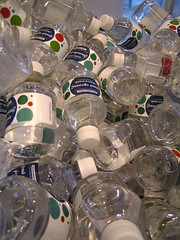
But, as my wise mom has been asking herself, what’s up with all these bottles? Why have crowds of us become convinced that we shouldn’t drink the tap water?
There are some places in the world where it is unsafe to drink what comes out of the faucet. I certainly do not live in one of those places. My water is just fine. It tastes a little funny to me sometimes, but I think it’s at least partly because I’m expecting it to not be as delicious as that prettily packaged, well marketed stuff that I pay a whole lot more for. Let me remind myself once again, that just because there’s a picture of a mountain lake does not mean that’s where the water comes from. It could just as well be municipal water from anywhere on the planet.
The cost of transporting the water from the bottling plant to the store is tremendous. Then there’s the waste. The caps are often not recyclable at all, and the “recycling” of plastic bottles is really better described as “downcycling” – it’s not the same as recycling a glass bottle, which can be made into another glass bottle. Plastic degrades as it is recycled, and therefore a plastic bottle cannot be used to make a new plastic bottle…that requires new plastic. That's assuming that the bottles even get recycled in the first place, which most aren't according to this article from MSN. Plus there’s a label on each bottle, and the cardboard tray that the bottles sit in together, and the plastic wrapped around all of that…all this for something we can get by turning the kitchen faucet!
Most of us have heard something about plastics being not so great for our health either. Read more here if you want to get all the nasty details about the possible health problems resulting from excess plastic use.
Let’s not forget to look at the financial side of all of this. California is one of the three states that requires a deposit on plastic bottles. I always recycle, but using my curbside bin, not by returning them to the store. So I pay 5 cents extra for every bottle of water I buy. According to one source, the average American drinks 210 half liter bottles of water each year - that's $10.50 just in deposits! As far as the cost of the water itself, the stuff from the tap is significantly cheaper than the stuff I used to buy in the store. So much cheaper that it is basically free in comparison. What’s not cheaper is the bottle to carry it around in.
Alternatives to plastic water bottles are limited. I suppose I could carry around a glass jar that I reuse, but that seems potentially dangerous and messy. The other option I’ve found is aluminum bottles. Sigg is currently the accessory du jour for those who are hip to the problems of plastics, but the company has actually been around for over 100 years. The bottles are pricey, but they should last virtually forever, according to information on their website. Plus there’s the sort of invaluable health benefit of 0% leaching of chemicals from the bottle to your drinks. I like the fact that you can buy a replacement cap if you break or lose yours, and not have to replace the entire bottle. They’ve also not neglected to appeal to our desire for pretty packaging and have a huge variety of designs to choose from (you can even mix and match the caps and the bottles!). When buy nothing month is up, I’m going to think about this one here.
The one concern I have to research a bit more here is the cleaning tablets and brush that you are encouraged to buy (more packaging; plus, what goes in to those cleaning tablets?). It seems from the sites FAQs that this extra purchase is probably not necessary.
So another rule is born...no more plastic water bottles!
Tuesday, April 8, 2008
Excited for an audit?
That was short-lived. I guess the good news is that we “passed” with flying colors. We have low flow toilets to start with, and with the chunks of cement I found outside to drop in the back of the tanks, he said they’re now really low flow. We have aerated faucets and low flow shower heads. Our dishwasher got the thumbs up, as did our washing machine. We don’t have any landscaping since we live in a townhouse, and the plants I do have I’ve been watering from a bucket that collects water while I shower. It was good to find out for sure that nothing is leaking.
I could replace the washer with a front loader. They use less water, less detergent, and help your clothes last longer. The thing is, our top loader works just fine. It seems like a waste of money to go buy a new one. Plus, the one we have already uses less water than older models (according to my water auditor, this one uses about 29 gallons per load, compared to older models, which apparently can sometimes use close to 50 gallons per load). I believe front loaders use about 16-24 gallons of water per load. Since I only wash about 3 loads of clothes in a week, I’d be saving a maximum of about 40 gallons of water a week, which is roughly equivalent to two seven minute showers.
If the front loaders were less expensive, I’d think about it anyway. The fact is, they cost a lot of money. The cheapest one I found in a quick, informal web search was $600, while most were closer to the thousand dollar mark, and several of them were even more than that. I just can’t justify that purchase to myself while our other machine is working just fine. If I was in the market though, I’d definitely be checking out the WashUp. How cool is that?
So what can I do to work with what I have? I did my own water audit, since the official one left me feeling very unsatisfied. I ended up focusing mainly on two appliances, the dishwasher and the washing machine, since I’d already addressed my water usage in the bathroom. I ended up looking at the energy as well as water usage of these appliances. Here’s what I came up with:
1. My dishwasher has a “water miser” setting. I’m using that from now on. I wish they gave it a better name though. This makes me sound grumpy.
2. I will continue using only the “air dry” setting on the dishwasher.
3. I will use the same water glass all day.
4. If I use a measuring cup or spoon for dry items, I will wipe it with a towel and not put it in the dishwasher.
5. I’ll use my towels for 5 or 6 days instead of 3 or 4.
6. There are some items that I just won’t re-wear, but I’ll try harder to wear some other items more than once, especially pants and sweaters.
7. I will continue to be extra vigilant about only running the dishwasher and washing machine when they are really (REALLY) full. I stuck a piece of paper to each machine and am going to write down the date each time I run it so I can monitor my usage more carefully and remain conscious of it.
8. I’m using only cold water in the washing machine. It really does work just as well.
9. I’m not using the dryer anymore. Dryers use a lot of energy, and as somebody pointed out, in the summertime, it’ll heat the house up when I’m really wishing it was cooler.
So that’s what I came up with…believe it or not, I’m actually kind of excited to get my next utility bills to see how effective this will be!
Friday, April 4, 2008
Updates
That said, I’ve scoured the net for ways to reuse some of my trash – so let it be known that I’m not taking credit for these as original ideas. I’m not all that creative, or I probably would have come up with more on my own. I actually thought I would find more cool, practical ideas than I did, but I guess that just reinforces the idea that reducing is really the best solution. Here are my results:
1. Toothbrushes: I plan to investigate purchasing a toothbrush with a removable head once I finish off the current stock. I probably have a dozen in my bathroom right now. So as I finish these (and the credit for this one goes to my dad) I will be using the waste-bin destined brushes for cleaning around the house. They are great for getting into all sorts of hard to reach places, like the fan cover in the bathroom, the tracks on a sliding shower door, and other nooks and crannies.
2. Mesh onion bags: I found one of these last week. It makes a great little pot scrubber if you cut the paper label out of the bag. Just fold the sides in all scrunched up so that it looks like a scrubby, and put a stitch through the middle.
3. Toilet tubes: In response to the questions (you know who you are!) I’m not giving up toilet paper any time real soon. But this idea will help me to use the leftover tubes in place of another item that I would like to cut out of my life: gift wrapping. It actually can make a cute little gift box that looks like one of those pop open party favors. Simple instructions are here. Ideally, I’d find something besides new ribbon to make it with.
4. Crayons: I don’t have any kids, but I was one once, and my mom came up with this cool idea way back when and we all loved it. We took all our old broken crayons, and rather than throwing them away, we melted them down, poured them into candy molds that we had lying around, and had new pretty crayons to color with.
5. Metal boxes from ground pepper: I’m going to fill it with sugar and throw it in my purse to carry for when I get coffee. I’ll be sure I always have unrefined sugar when I get coffee, and I’ll save the trash made from the paper packets. I’m also going to fill a few with baking soda to keep in the bathrooms for cleaning (the cardboard boxes don’t hold up well when they get wet).
6. Paper wrappings from reams of copy paper: Another gift wrapping solution. Remove wrapper carefully so you don’t tear it except along the seams. Decorate the blank side and use as gift wrap.
Other updates (keeping myself accountable!):
VTA – I mapped out my trip (Google maps now has a feature that lets you map your trip using public transportation). Turns out a 6.3 mile trip was going to take more than an hour. I figured I could walk that far in about an hour and a half and get some exercise while I was at it. It started pouring about 5 miles into my trip. I sort of forgot about having to walk back too…so I got a ride home. But I still got some exercise.
CSA – I found one that had some space available and got signed up. I should start getting my produce in a week. Hooray!
Purchases – I cheated a bit on my shopping list, but did pretty well. I did find some plastic bins for organizing my kitchen drawers on sale at Goodwill for forty cents apiece, so I grabbed those (at least they weren't new). I bought a cheese grater, but that is something that’d been on my list since December, so no problem there. I also resisted the urge to buy the one that had a plastic bottom and a cool plastic grip handle and got the one entirely made of metal. The problem is that I bought it at Ikea. That’s a hard place to get out of with only one item. I did cave in and get a wire under-desk organizer. We have no drawers on our desk and the clutter has been driving me nuts for months. But enough excuses, because today I signed up for the “Buy Nothing Challenge” on Crunchy Chicken’s blog – guess that means that shower timer will have to wait a little more than two weeks. The good news is that we’re still allowed to buy food.
Shower waste water bucket – I found a five gallon bucket in the garage. I have put it in the shower for the last three days now, and my plants thank me for that. What really amazed me was the volume of additional water in the bucket on the day that I washed my hair. It was more than twice the amount on the non-hair wash days. Can I get away with washing on every third day rather than every second? I’ll look at the calendar and make sure I don’t have to be anywhere before I test it out.
Buying in Bulk – Kidney beans grow a whole lot when they’re cooked. I now have nine cups of them. Recipe suggestions anyone?
Tuesday, April 1, 2008
bathroom reading
The consumables that I can find alternatives to will be dealt with separately. For now, I'm going to think about the water consumption, and the one consumable I don't plan to stop using - toilet paper. Basically, I've just been thinking about it when I use it. By that, I mean I think, do I need to take a foot of this stuff, or could I get by with a little less? That's it. We have quite a stock from a warehouse place at the moment, but when that runs out I'll be putting some thought into what brand I buy. I'll let you know what my research turns up.
On to the water usage. If it's yellow, let it mellow. Pretty self explanatory. Not recommended when using public restrooms.
So I hadn't yet put a brick in the back of the tanks, because I hadn't gotten around to going to a store to buy a brick. Wow, I am so trained to buy, buy, buy! It finally hit me today that outside, there are a lot of rocks...hey, how about I put a free rock or two in the back of the tank? Problem solved! For free! Less water used in every flush. Reduces my water consumption, and saves me money on the water bill. Hooray!
In India, the showers all have a large bucket with a smaller "mug" inside. You don't stand under a stream of hot water. You fill the bucket with water from the tap, then use the mug to dump the water on yourself when you need it. It's a pretty cool idea, and I'm sure it uses a small fraction of water when compared with the typical North American shower. That said, while I was in India, a nice hot shower was one of the things I missed most. As a compromise, I'm thinking of investing in a shower timer (after writing it on my shopping list and waiting two weeks, of course).
I've also started using that silly looking shower cap I've had lying around. I wear it every other day and wash my hair on the alternate days. I'm lucky my hair doesn't need every day washing. I save time, therefore saving water. My better half has always turned the water off while soaping up. I will steal this idea next time I'm in there. I have a feeling it will cut down on my tendency to get lost in thought while standing in there.
My other resolution for tomorrow's shower is to find a bucket to put in there to collect the water to use for my plants. This will allow me to reduce my water consumption by not having to turn the tap on to fill the bucket later, and allow me to reuse some water that would otherwise go down the drain. Also, I'm hoping that I might trip over the bucket while I'm in there and be more likely to actually remember to water the plants in the first place.
Yes, I turn the tap off when I brush my teeth.
And a final word on the weekly challenge to myself (find as many ways to reuse things that are already in the house) I am making some progress on this front. A partial list of things I will find a way to reuse includes:
toothbrushes
plastic bottle caps
plastic mesh onion bags
toilet paper tubes
I'll reveal the fabulous second lives of these items on Friday. Until then, don't throw any of these items away!